Schools are charged with helping students develop the skills needed to thrive in adulthood. But most of what we know about how students’ skills relate to their success as adults comes from nationally representative survey data. For schools to be more active, intentional, and accountable catalysts of mobility-boosting skills, they would ideally be able to leverage the data they collect most readily, namely test scores and grades.
This research team investigates whether skill proxies, like subject-specific test scores, subscores, and course-specific grade point averages (GPAs), are related to early mobility outcomes (e.g., high school graduation and postsecondary education) and adult mobility outcomes (e.g., earnings from ages 29 to 32). Using descriptive and quasi-experimental methods, the team analyzed more than 15 years of longitudinal data from the Maryland Longitudinal Data System (MLDS) on more than 3 million student-years.
They found students’ math test subscores were substantially more related to adult earnings than English language arts (ELA) scores. Looking at subscores as skill proxies, they find that although a broad range of academic skills predicts bachelor’s degree completion, earnings are more strongly associated with transferable skills such as applied math reasoning, modeling, and written communication, highlighting a distinction between competencies that support educational attainment and those rewarded in the labor market.
Using readily available data to generate more insights can help school districts and policymakers better assess whether students are developing the skills they need to achieve economic success as adults.
Key Takeaways
Both math and ELA test scores were associated with higher adult earnings, though math scores had a much higher earnings premium. Among students with adult earnings data captured in the MLDS, an elementary or middle school (grades 3–8) standardized test math score that was 1 standard deviation higher, roughly equivalent to moving from the 50th to 80th percentile on the test, was associated with an $8,100 increase (a 17 percent increase) in annual earnings at ages 29 to 32, after accounting for students’ demographics and ELA test scores. By comparison, having an ELA score that was 1 standard deviation higher was associated with a $2,200 increase (4.5 percent) in earnings at ages 29 to 32 after accounting for differences in students’ demographics and math test scores.
This pattern held for postsecondary outcomes as well. A 1 standard deviation higher math score was associated with a 9.2 percentage-point higher likelihood of on-time college enrollment, a 7.7 percentage-point higher likelihood of getting a bachelor’s degree in a STEM subject (science, technology, engineering, and mathematics), and a 12 percentage-point higher likelihood of getting any bachelor’s degree compared with increases of 7.9, 2.5, and 7.7 percentage points, respectively, for a 1 standard deviation increase in ELA scores.
For high schoolers who had math, ELA, social studies, and science scores, the researchers find that a 1 standard deviation increase in test scores is related to an increase in earnings at ages 29 to 32 of about $4,200 for math, $500 for ELA, $1,200 for science, and $1,900 for social studies (see figure).
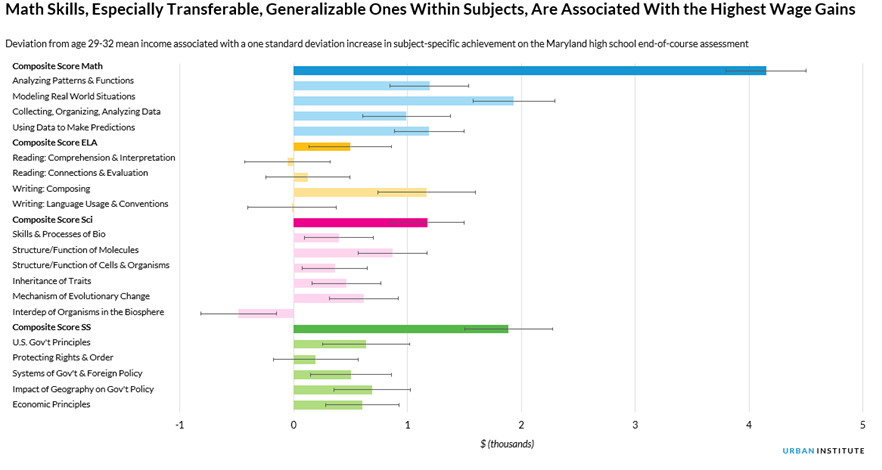
Source: Research team's analysis
For both age groups and most outcomes, math score findings stay the strongest after controlling for differences in demographics and GPA, suggesting a more direct relationship between math scores and outcomes than for other subjects. Potential direct effects between subject-specific skills and wages suggest that postsecondary attainment may not always be a strong proxy for economic outcomes.
Math wage returns were greater for students who were not eligible for the Free and Reduced-Price Lunch (FRL) program compared to those who were and for white students compared to Black students. However, the ELA wage return was greater for FRL-eligible students compared to FRL-ineligible students and for Asian students and Black students compared to White or Hispanic students.
When examining the subscores that feed into subject-level scores, the authors found a clear distinction between the skills that predict bachelor’s degree attainment and those that predict earnings. Most academic subscores are at least moderately predictive of bachelor’s degree attainment, indicating that college completion draws on a wide base of competencies. But earnings are more strongly linked to specific transferable skills, particularly applied reasoning, real-world modeling, explanation, and written communication, while content-heavy recall measures, like recalling specific terms or formulas, show weaker or inconsistent relationships (see figure above). These patterns suggest that although many skills help students finish college, the labor market places greater value on generalizable abilities that involve synthesizing information and applying knowledge in new contexts. At the same time, content-specific knowledge may still influence students’ choice of major, even if it is less directly rewarded in earnings.
Prior research using survey data shows strong links between cognitive skills and earnings, with math skills yielding higher returns than verbal or literacy skills, with one study reporting returns on numeracy roughly twice those on literacy. Using population-level administrative data, this study finds even larger returns on math—nearly four times those of English—and shows that transferable, generalizable skills within subjects are especially valuable for future earnings.
Potential Implications for Policymakers and Practitioners
Additional validation and translational work are needed to bolster these findings and enable their uptake into policy and practice settings, but SUMI sees the following potential applications:
Integrate subject-level math scores into current mobility and workforce readiness frameworks. Schools and states could consider subject-level math standardized test scores, especially from high school, as proxies for skills that drive mobility in adulthood.
Embed and prioritize cross-cutting skills that strengthen students’ core competencies. Curriculum designers and teachers could leverage certain approaches and content to ensure the key skills identified in this and follow-up studies are emphasized (e.g., transferable math skills, composition).
Invest in high-impact educator development and student support systems that build key skills essential for lasting student outcomes. District superintendents and other local leaders could similarly prioritize investments in teacher training and student supports in line with key skills that promote long-term success.
Future Research Directions
Future research could explore the following:
- how to use these findings as benchmarks when estimating other earnings-focused long-run impacts of skills
- how to further explore the importance of math skill development, both via direct pathways and through college degree attainment, on earning a STEM degree and higher adult earnings
- how these relationships may change based on how old students are when their economic mobility outcomes are measured (earnings at age 25 versus at age 35)
- how to grapple with the relative importance of writing skills as artificial intelligence emerges as a tool
- developing tests that better measure skills that are predictive of college attainment and earnings
- evaluating changes in teaching curricula that better align with the skills identified in the study
Methods, Data Sources, and Measures
To understand how skill proxies were related to long-term student outcomes, the research team analyzed administrative data from the Maryland Longitudinal Data System (MLDS) on public school students enrolled in Maryland between 2008 and 2019. The skill proxies examined by the researchers include standardized test scores and subscores in math and ELA for elementary and middle school students, as well as math, ELA, science, and social studies GPAs for the same grades. For high school students, the proxies include standardized test scores and subscores in Algebra I, English 10, Biology, and U.S. Government, along with GPAs in the four core subjects.
The research team then linked these skill proxies to adult outcomes captured in the MLDS up to 2024. The outcomes they examined include average annual earnings between ages 22 and 32, high school graduation within four years, on-time college enrollment, associate’s degree within four years, bachelor’s degree within six years, and degree field.
The researchers also analyzed the relationship between skill proxies and adult outcomes by demographic characteristics, including eligibility for free and reduced-price meals, student race or ethnicity (Black, Hispanic, white, Asian), and overall achievement quartile.
Disclosures
This research discussed in this summary was conducted using data from the Maryland Longitudinal Data System (MLDS) and was supported by the MLDS Center, whose staff provided valuable technical assistance. The findings and conclusions are those of the authors and do not necessarily reflect the views of the State of Maryland, the MLDS Center, the MLDS Governing Board, or its partner agencies.
Conrad's contribution to the research discussed in this summary is part of the National Science Foundation Graduate Research Fellowship Program under Grant No. DGE 2236417. Any opinions, findings, conclusions, or recommendations expressed in this material are those of the authors and do not necessarily reflect the views of the National Science Foundation.
Research Team
Nolan Pope
Principal Investigator, University of Maryland, College Park
Cameron Conrad
RAND Corporation
George Zuo
RAND Corporation
Emerging Insights
Skills that drive student upward mobility
Measuring skills that drive student upward mobility
External resources
Skills that Pay: Subject-Specific Test Scores and Long-Run Outcomes (PDF)